Ten years in the workshop, two boards to show for it
We'll show you how we designed Evo-Spirit's first electric mountainboards, from the very first prototypes to the final versions.
The Nexus and Nexus Pro are Evo-Spirit's first electric mountainboards, the culmination of over 10 years of prototyping. These two 6,400 W all-terrain boards hit up to 55 km/h in sport mode and share the Xplorer V2's battery. The only real difference between the two is the drivetrain: the Nexus uses a drive belt, while the Nexus Pro features a Gear drive.
In the workshop, the full story on video
We'll go through the prototype parts, the mistakes, and the technical choices. We'll explain how we arrived at the Nexus and Nexus Pro.
Filmed at the Evo-Spirit workshop with Hugo.
A project over 10 years old
A long-term project
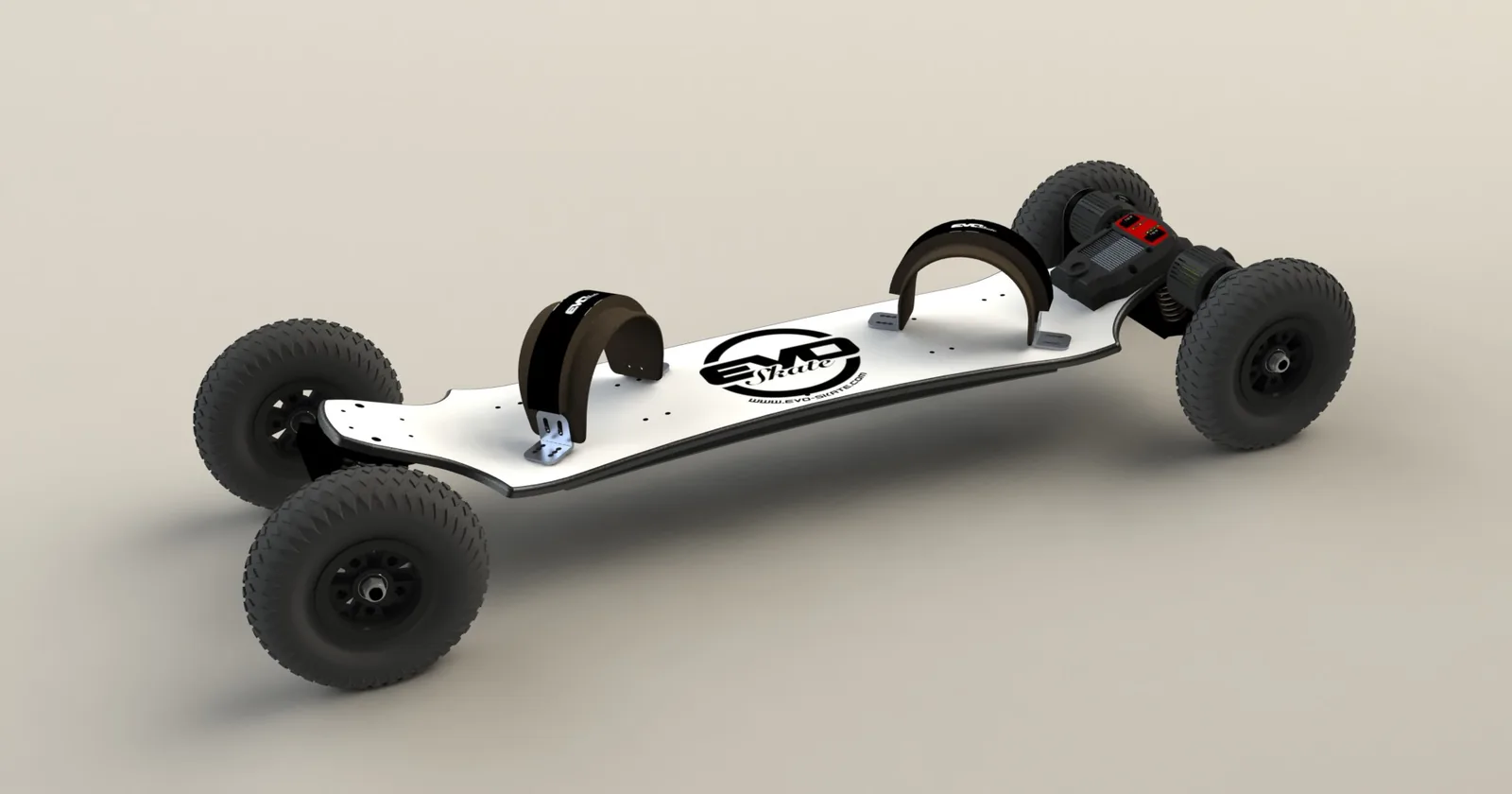
Very few people know that the mountainboard project at Evo-Spirit is over 10 years old. The first discussions and prototypes date back about a decade. This long-term project stayed in the workshop because we were never fully satisfied with the board.
To tell you this story, we brought in Hugo from the workshop. He has been mountainboarding for over 15 years, first without a motor and then with an electric one. Max tested a large number of the prototypes.
Why we had never commercialized it
A matter of feel, not a calendar.
We never released a mountainboard before because we weren't satisfied with the testing. We never achieved the right feel. The acceleration curves were sometimes too violent with older electronics, and we had range issues because battery technologies weren't perfected at the very beginning.
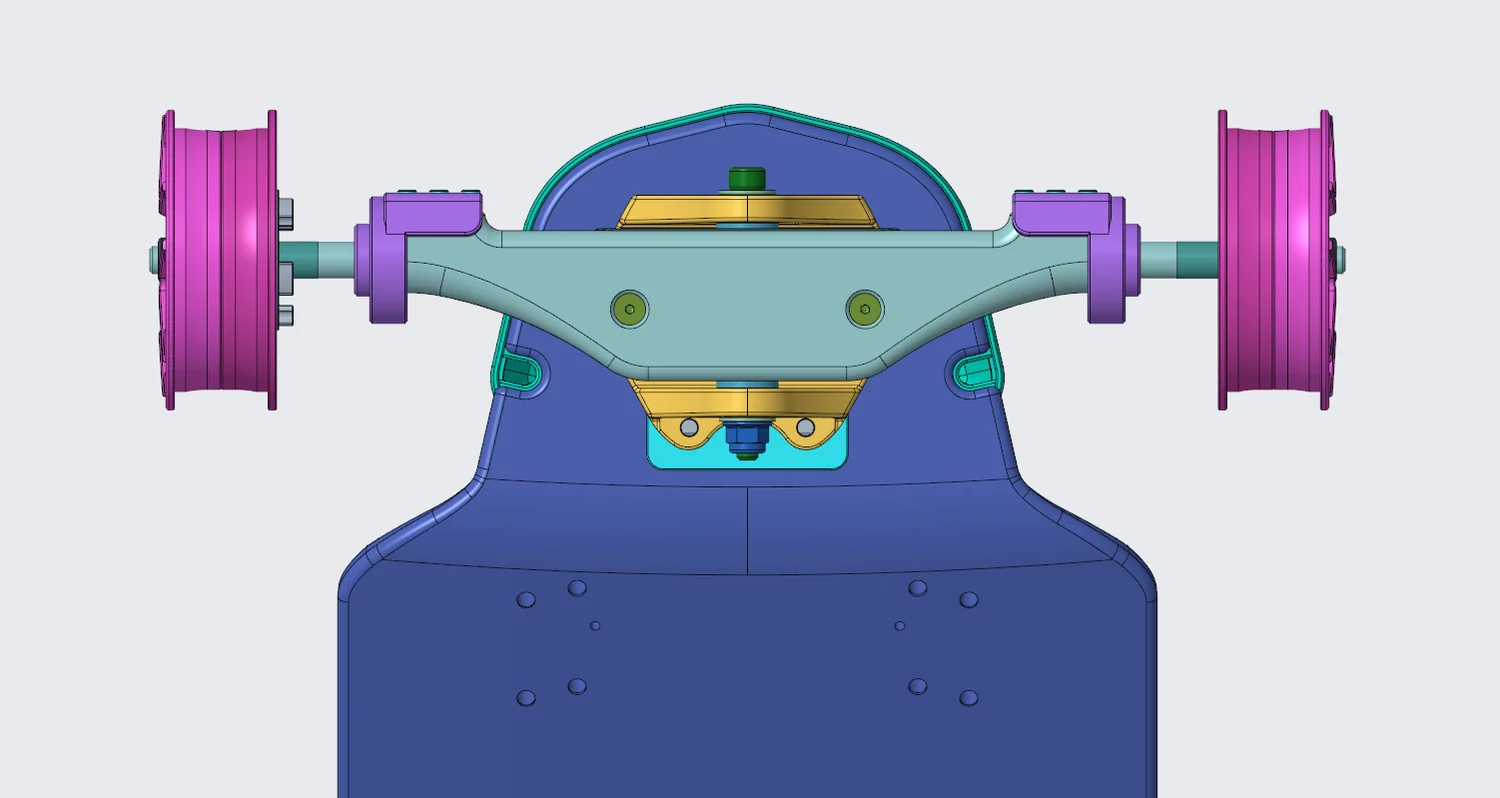
The last prototypes used 9-inch drive belts. With 5,000 W and high torque peaks, a drive belt wasn't always the best idea when accelerating hard on gravel or grass. That's why we switched to Gear drive: at 10,000 W, we'd honestly break a drive belt almost every session. On the Nexus, which has a bit less power, the drive belt remains fully relevant; we'll come back to that below.
The advantage of a workshop that tests hard is that we're usually the first to break parts. We conducted very thorough tests, breaking things no one else would probably have managed to break. The result: we fix the slightest problem before it reaches the final products.
The electronics of the Xplorer V2
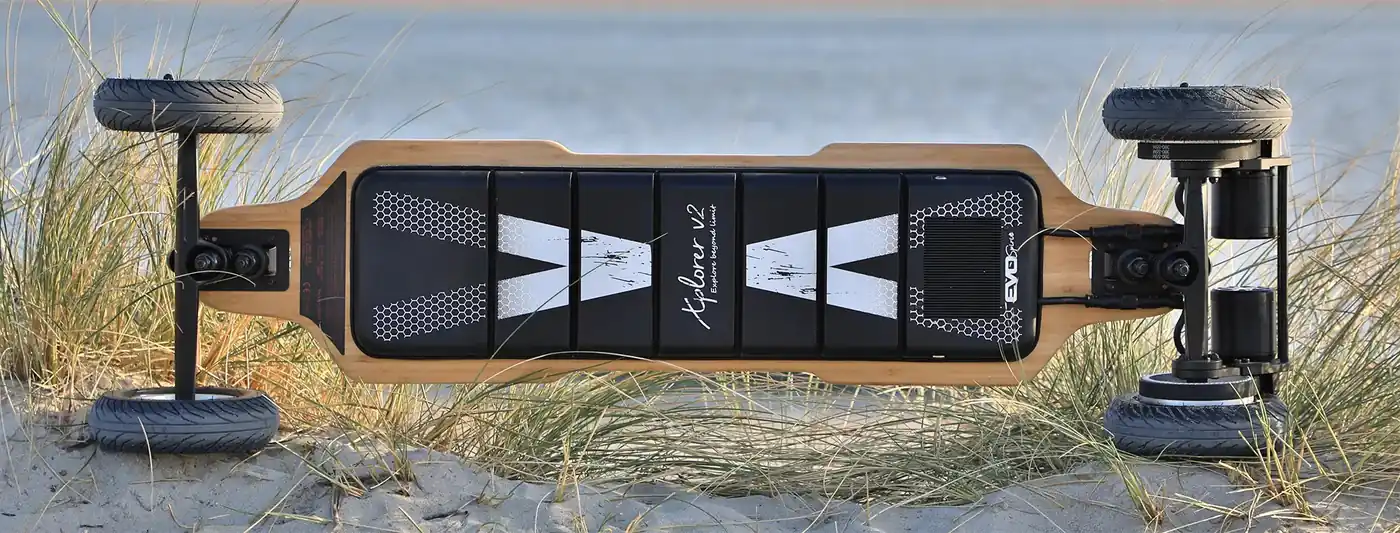
The release of the Xplorer V2 truly unlocked the project. This board offered an incredible feel, a real step forward in electronics. We realized we could reuse these already perfected electronics and simply adapt the mountainboard part.
A mountainboard, however, uses completely different trucks, has unique deck requirements, and develops power in a way that's nothing like an electric skateboard. It's a whole new world, demanding a different ride. We started by putting Xplorer V2 electronics on a mountainboard deck, and it worked. That's when the real adaptation began.
30° angle, flex and strength
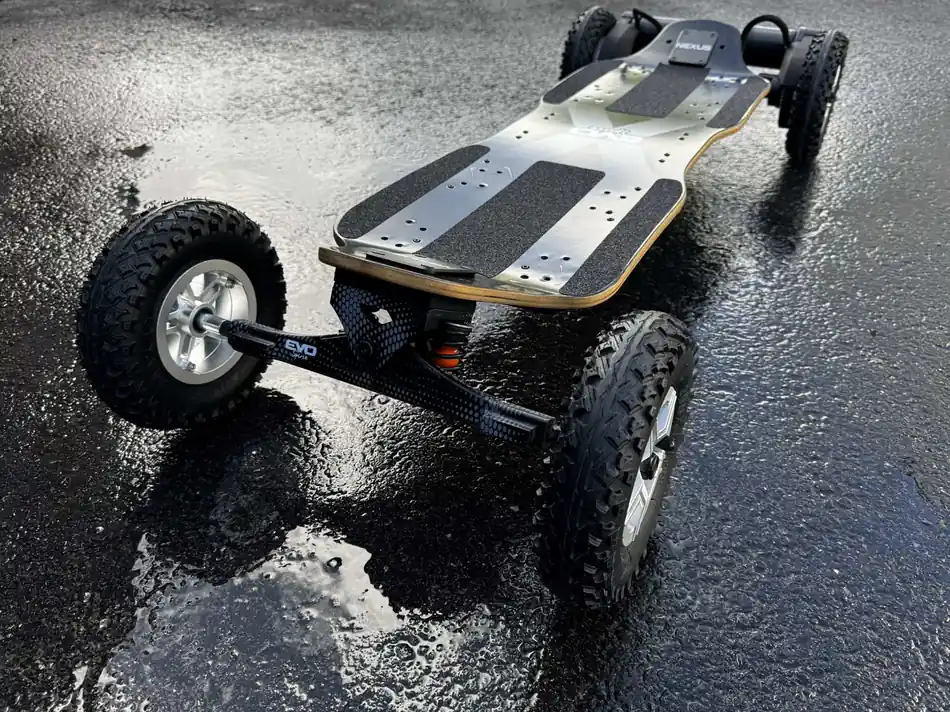
Our initial mountainboard experience involved decks with a 15° angle, very narrow, and not very flexible. For the Nexus and Nexus Pro, we upgraded to a 30° angle, significantly more width underfoot, and added flex. This is standard for mountainboards. When you're riding all-terrain, this flex absorbs shocks, which is especially important on a board that weighs around 17 to 18 kg, depending on the model.
We opted for more resistant boards, even if it meant a slight increase in weight, to boost reliability. We've ridden hard, landed backflips, and pulled off countless tricks with serious airtime, and we still haven't broken a deck. We really put them to the test: we didn't try to shave off 200g for a thinner profile, and that's why our boards are so solid.
6,400 W, plenty of torque, well-tuned
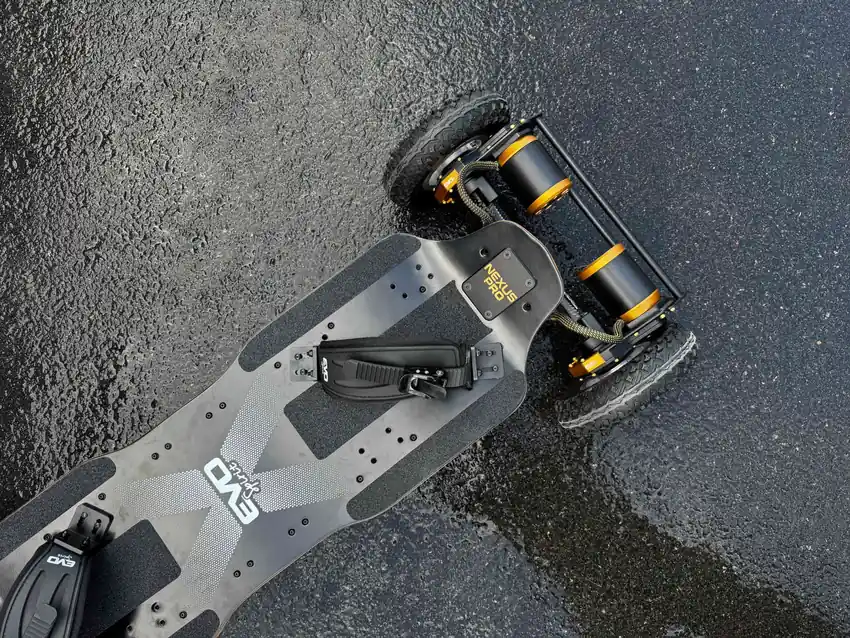
Under the deck, you'll find 6,400 W of power. Simply put, that's a lot of power and a lot of torque. In sport mode, you can hit 55 km/h. Most importantly, compared to earlier motors, this setup is incredibly well-tuned. You manage acceleration power with the remote control, choosing from different modes.
We use the same controller as the Xplorer V2, but with slightly larger motors that can handle more watts. The goal was to deliver more torque to compensate for all-terrain boards, which feature larger, softer tires.
Adjustable spring trucks
We went with classic mountainboard spring trucks. There are no suspensions; the spring simply aids turning and provides more stability than a skateboard truck. You can tighten the springs: if you want to ride in a straight line at full speed, you'll lose a bit of maneuverability but gain significant stability.
A huge advantage is the ability to adjust the front and back independently. This lets you fine-tune the board's behavior to match your terrain and riding style.
8-inch knobby tires and under-deck battery
8-inch knobby wheels
Classic 8-inch knobby tires are the best for all-terrain riding. They provide excellent ground clearance and obstacle crossing, yet remain maneuverable enough for carving in the city.
Battery under the deck
On our Evo brand, which we distribute with the Renegade, we've proven the under-board battery pack's durability: we do boardslides on rails, take 2-meter drops, and neither the pack nor the deck breaks.
Placing the battery underneath creates a very low center of gravity. This eliminates the tipping effect during angle changes: the lower the battery's weight, the better the carving feel and the better the stability. This makes the board comfortable both all-terrain and in the city.
This battery is the same one found in the Xplorer V2 and Xplorer V2 Pro. We chose to use the same battery across all four models. This offers a huge logistical advantage: we stock fewer different parts, and we always have parts in France to help you out. We've been riding this type of battery on prototypes for almost two years, with excellent feedback, so we know we won't have problems, and neither will our customers.
The key figures
Nexus or Nexus Pro: drive belt or Gear drive
The main difference between the two is the drivetrain. Everything else is the same.
Nexus, drive belt transmission
You can fit a much wider range of wheels on this board. In the city, the drive belt is quieter. It takes a while to realize it's an electric board, so it's far less noticeable from 100 or 200 meters away. The downside: in severe all-terrain conditions, a drive belt can break if a stone gets caught in the wrong place.
Nexus Pro, Gear drive transmission
With a closed circuit, nothing gets into the drivetrain, no matter what you ride through. You can hit all-terrain trails without breaking anything. The trade-off is slightly fewer wheel options, and you'll need to re-grease the Gear drive every 1,500 km. The Nexus Pro also comes with gold finishes.
| Criterion | Nexus | Nexus Pro |
|---|---|---|
| Drivetrain | Drive belt | Gear drive, closed circuit |
| Wheel choice | Extensive | Limited |
| Dedicated all-terrain | Drive belt exposed to debris | Protected drivetrain, impervious to debris |
| Noise in urban areas | Very quiet | Slightly more audible |
| Drivetrain maintenance | Regular drive belt inspection | Regreasing every 1,500 km |
| Finishes | Standard | Gold |
| Power, battery, deck | Identical on both models | |
Speed-Limited or Sport version, the choice is yours.
Both models are available in a Speed-Limited Version or a Sport Version. The Speed-Limited Version is limited by design to 25 km/h and comes equipped according to French decree n° 2019-1082. This allows you to ride it on public roads in France, provided you follow the Highway Code. The Sport Version exceeds 25 km/h, so it is not permitted on public roads and is for private grounds only.
The remote control is the same as on our other models. It features a CNC casing for a solid grip. You can purchase it separately, for example, if you get a Nexus but still want the remote control casing.
Our ride feel
These boards cater to two distinct rider profiles. The mountainboarder profile, a bit more specialized, will appeal to those coming from snowboarding or riders who really want to push their limits. Then there's the electric skateboarder profile, seeking a board primarily for transportation. If you're choosing between an Xplorer V2 and a Nexus and want straps, the Nexus is your only option.
Straps give you the advantage of pulling on the board. You're no longer just relying on your heels or toes; you also pull the strap when you turn. This adds a few degrees of angle to the deck, significantly enhancing the carving sensation. When the deck leans more, the trucks turn more, and that's where you'll feel a real difference in the ride.
When cruising on trails, it's easy to hit 30 to 35 km/h on rough terrain. These boards are agile, yet fitted with large tires for tackling obstacles. On a bumpy field full of holes, your foot slides all over without straps, even with good grip. With straps, you keep moving forward. The only thing we've managed to bend is a truck, and that was after repeated 3-meter jumps, which also happens with a classic 6-kilo mountainboard. For jumping, it's incredible: great stability and good pop despite the weight. This allows for high air on kicks. What limits you on steep slopes is tire grip, long before the electronics reach their limit.
Who it's for, and its limitations
It's for you if...
- You want a board that goes everywhere: all-terrain on weekends and city riding during the week.
- You come from snowboarding, skiing, or longboarding and want to rediscover carving.
- You love to go big: jumps, kicks, tricks, with a board that can take a beating.
- Reliability and after-sales support with parts in France are important to you.
Limitations to be aware of
- We've prioritized durability, so the 17 to 18 kg weight is a deliberate choice. If you're looking for the lightest board for smooth city rides, an Xplorer V2 will be perfect.
- On the Nexus, the drive belt can break during extremely aggressive all-terrain riding.
- The Nexus Pro's Gear drive limits your wheel choices and requires regreasing every 1,500 km.
The Nexus and Nexus Pro are the culmination of 10 years of dedication, finally delivering two electric mountainboards worthy of our name: they're tough, versatile, and built to last.
Frequently asked questions
Evo-Spirit designs and tests its electric mountainboards in Pornichet (Loire-Atlantique). The Nexus and Nexus Pro are the brand's first, the culmination of over 10 years of prototypes. They share 6,400 W, 55 km/h in sport mode, 8-inch knobby wheels and the Xplorer V2's battery. They differ only in the transmission: drive belt on the Nexus, Gear drive on the Nexus Pro.
What's the difference between the Nexus and Nexus Pro?
The only real difference is the transmission. The Nexus runs on a drive belt, which is quieter and gives you more wheel options. The Nexus Pro features a closed-circuit Gear drive, keeping debris out for severe all-terrain use, and it comes with gold finishes. The power, battery, and deck are identical on both models.
What battery does it use, and where can I find parts?
Both models share the same battery as the Xplorer V2 and Xplorer V2 Pro. This battery is common across all four models in our range. This means we keep fewer parts in stock. We always have what you need in France for quick after-sales support. We've been running this battery type in our prototypes for nearly two years, and the feedback has been excellent.
How about speed and power?
You'll get 6,400 W under the deck and a top speed of 55 km/h in sport mode. Adjust the acceleration power with the remote control, choosing from modes that range from gentle to aggressive. We use the same controller as the Xplorer V2, but with slightly larger motors for increased all-terrain torque.
Can I ride it on public roads?
In France, both models are available in a Speed-Limited Version. This version is limited by design to 25 km/h and comes equipped according to French decree n° 2019-1082. You can ride it on public roads in France, provided you follow the Highway Code. The Sport Version exceeds 25 km/h, so it is not permitted on public roads and is for private grounds only. If you're riding outside of France, always check your local regulations.
How much does the board weigh?
Depending on the model, the weight is between 17 and 18 kg. This weight is a conscious choice: we prioritized building more durable boards over shaving off 200g. We've ridden these hard, landing backflips and big airtime, without a single deck breaking.
Does the drivetrain need maintenance?
On the Nexus, you'll need to keep an eye on the drive belt, especially during aggressive all-terrain riding where a rock could damage it. The Nexus Pro's Gear drive is a closed system and only requires regreasing every 1,500 km, with no risk of rock-related damage.
Want to go everywhere, city and all-terrain?
The Nexus and Nexus Pro are designed and tested right here in Pornichet. We keep all parts in stock, so you can keep riding for years to come.
This article was written based on the workshop video filmed with Hugo from the Evo-Spirit workshop.
 Evo-Spirit
